Application Modernization: Moving Legacy Systems to the Cloud Without Downtime
Legacy systems still run critical operations in many Saudi organizations. Modernizing them does not have to mean a risky big-bang rewrite.
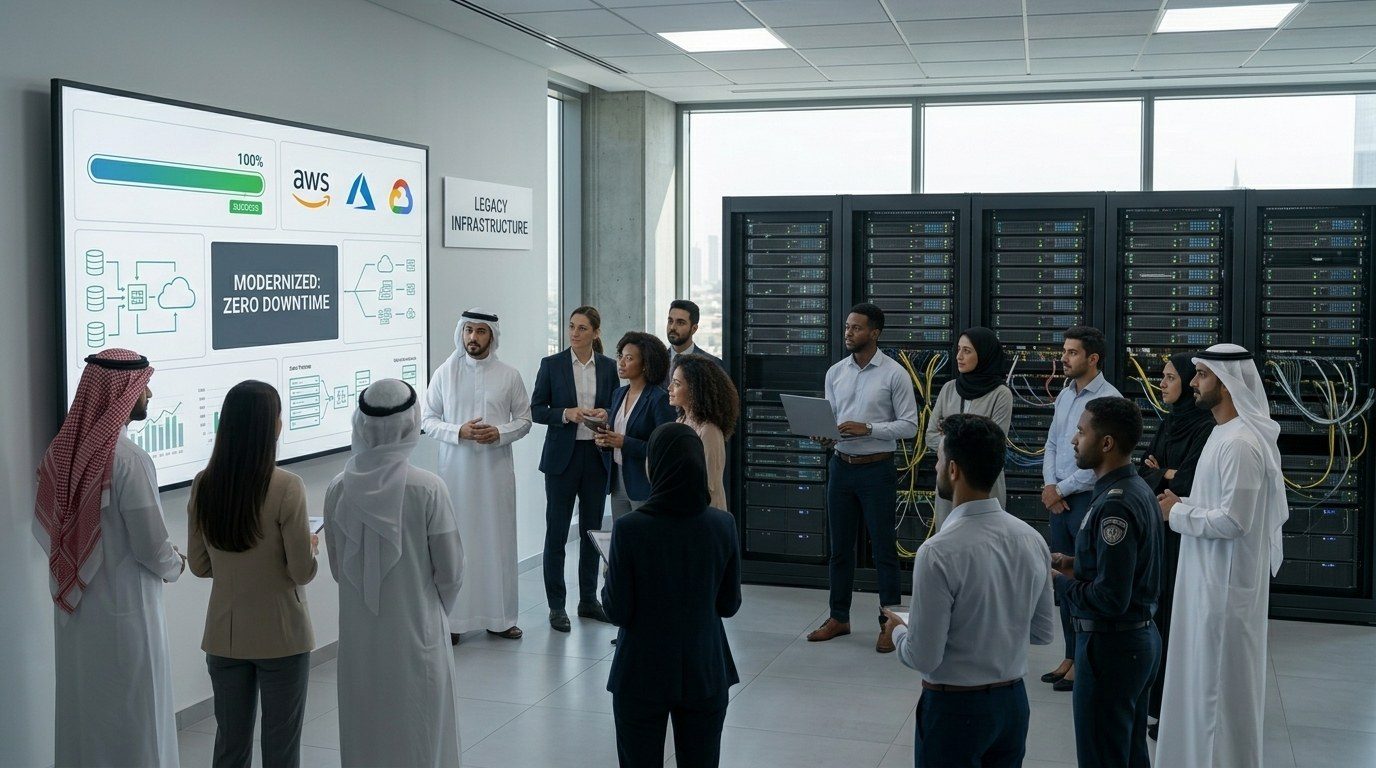
Legacy application modernization is now on most IT roadmaps, because many organizations depend on applications built ten or more years ago. They work, but they are slow to change, hard to scale, expensive to host and increasingly difficult to secure. Developers who understand them are retiring or moving on. Modernization addresses these risks while protecting the business logic that still has value.
Signs your application needs modernization
- Small changes take weeks and often break something else.
- Performance drops at peak times and the system cannot scale.
- The technology stack is no longer supported by its vendor.
- Integrating with new systems or mobile apps is difficult.
- Security patches are delayed or unavailable.
Five modernization strategies
Rehost
Move the application as it is to modern infrastructure or the cloud. Fastest, with immediate hosting and reliability gains, but the code stays the same.
Replatform
Move to a managed platform, such as a managed database or container service, with small changes to the code.
Refactor
Restructure the code, often into services, to improve maintainability and scalability without changing what the application does.
Rebuild
Rewrite the application on a modern stack, reusing the business rules. Suitable when the old code cannot be saved.
Replace
Retire the application and adopt a ready-made platform, such as one of our industry solutions.
Microservices and containers, in plain terms
A microservices architecture splits one large application into smaller services, such as billing, users or notifications, that can be updated and scaled independently. Containers package each service with everything it needs to run, so it behaves the same on a developer’s laptop and in production. Together they make releases faster and safer. They also add operational complexity, so they suit systems that genuinely need independent scaling.
Hosting and data residency in Saudi Arabia
Before moving to the cloud, classify your data. Government entities and regulated sectors may have rules on where data must be stored, and the Personal Data Protection Law (PDPL) governs how personal data is processed and transferred. Several major cloud providers now operate data centers inside the Kingdom, which makes compliant cloud hosting more practical. Our optimized hosting service covers cloud, dedicated and hybrid options.
How to migrate without downtime
- Assess. Inventory the application, its dependencies, data volumes and integrations.
- Strangle gradually. Route one function at a time to the new system while the old one keeps running.
- Sync data. Keep old and new databases in sync during the transition.
- Test in parallel. Compare outputs of both systems with real transactions.
- Cut over in stages with a tested rollback plan.
Where to begin
Start with a short assessment of your most critical application. It will tell you which strategy fits, what it will cost and what can be delivered first. Learn more about our application modernization services.
Explore the services and solutions mentioned in this article.
Frequently asked questions about legacy application modernization
Is it better to rewrite or refactor a legacy application?
Refactor when the core logic is sound and the main problems are structure and scalability. Rewrite when the technology is obsolete or the code is too fragile to change safely.
Can we move to the cloud and keep data in Saudi Arabia?
Yes. Several cloud providers operate regions inside the Kingdom, and hybrid setups can keep sensitive data on local infrastructure.
How long does application modernization take?
Rehosting can take weeks. Refactoring or rebuilding a core system usually runs in phases over several months, with value delivered after each phase.